
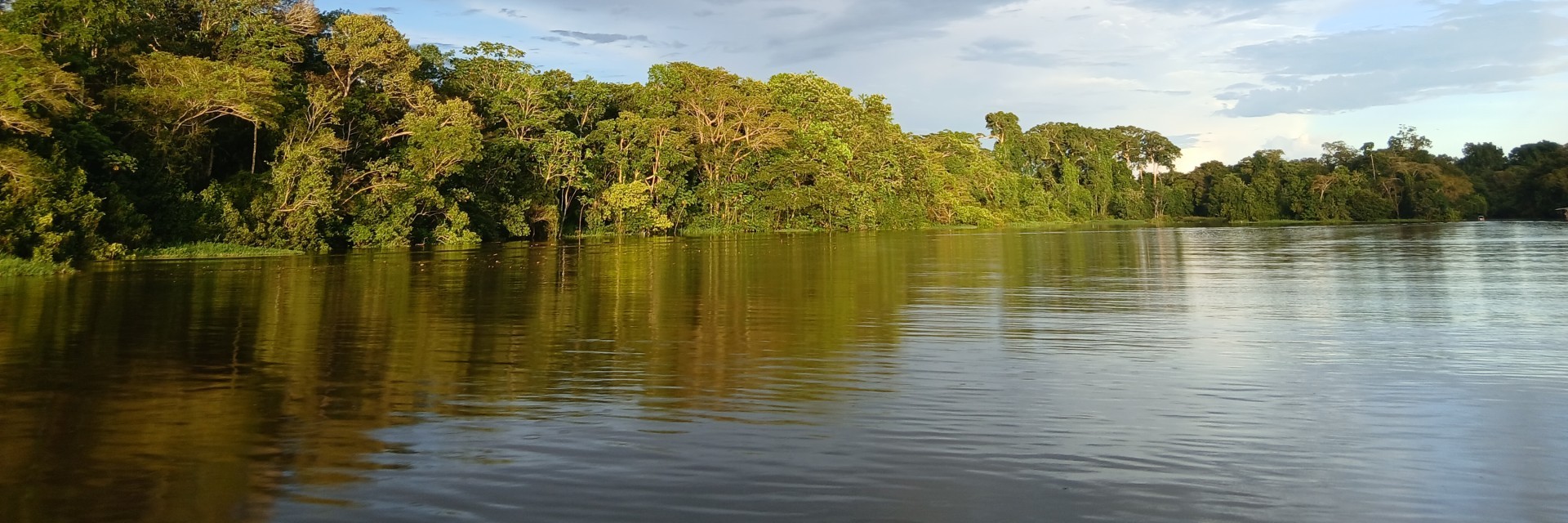
Agriculture and the soils of Amazonia
In Amazonia the earth is clayey and poor in organic nutrients of which the layer doesn't exceed 5 cm.
This explains why all the roots stay on the surface and why the trees have “wings” at their base which allow them to stay stable.
In the indigenous villages, which you will have the occasion to visit during your excursions in Amazonia, people produce manioc, maize, pepper, pineapple, chontaduro (palm tree); they go fishing with nets (non-traditional fishing), with the fishing rod and the lance (traditional methods), and mostly at night. In the past, the indigenous manufactured torches with a resin called copaïba, for the hunt and the nocturnal fishing, practised today with an electrical lamp.
As the soil is poor in organic nutrients, people use the agricultural technique slash-and-burn. Trees are burnt and their ash serves as fertilizer. In the chagra one produces manioc and fruits during 1 to 2 years maximum. Then, while the fruit trees are being preserved, one needs to cut down and burn the forest aside in order to keep on producing. The first orchard or Chagra doesn't suit any more but for the big fruit trees which continue to be exploited for several years to come. There are often three active chagras: an old one for the fruit trees, one of 1 to 3 years and one new, recently sowed.
The native populations know how to handle their production according to their needs. Hence the trees are cut down on around 1 to 4 hectares, by the use of iron axes, which constituted the first exchange currency brought to them by the colonizers in exchange of orphans which were then brought back to Europe.
In former times they used stone axes, and those who didn't have access neither to one nor to the other, lit a fire underneath the tree to make it fall. The iron axes represented an enforcement of power for the chiefs who this way could cultivate more easily and faster for their clan.
The quantity of food a chief possessed reflected as a matter of facts his power and his ability to feed his kind. Particularly when he invited other clans he wished to impress, for the celebration of the natural cycles in his maloca, the traditional house that you can visit during your journey in Amazonia. Moreover, the chief had to know about medicine and the cycles of diseases in order to be able to protect his clan against epidemics.
In the distribution of the tasks in the clan the men cut and burn the trees, they chase, go fishing and search for medical plants. The women cultivate, harvest, prepare the food and transform and manage the medicine.
Coca and Tobacco
Paradoxically for our occidental culture, coca and tobacco are the master plants of the traditional Amazon medicine. Their handling is very delicate and using them requires precise knowledge. As they are toxic plants they are efficient against bacterium and fungus. Moreover they serve as worm powder, facilitate scarring and digestion and are stimulating.
Coca and tobacco are traditionally chewed. The plants have a very important spiritual signification in the indigenous culture. They are at the same time opposed and complementary and they represent the creator of the universe.
The Indians you will be able to meet during your voyage in Amazonia are animists. If one makes a comparison to Buddhism, one could say that coca and tobacco represent yin and yang, whose union symbolizes the Tao.