
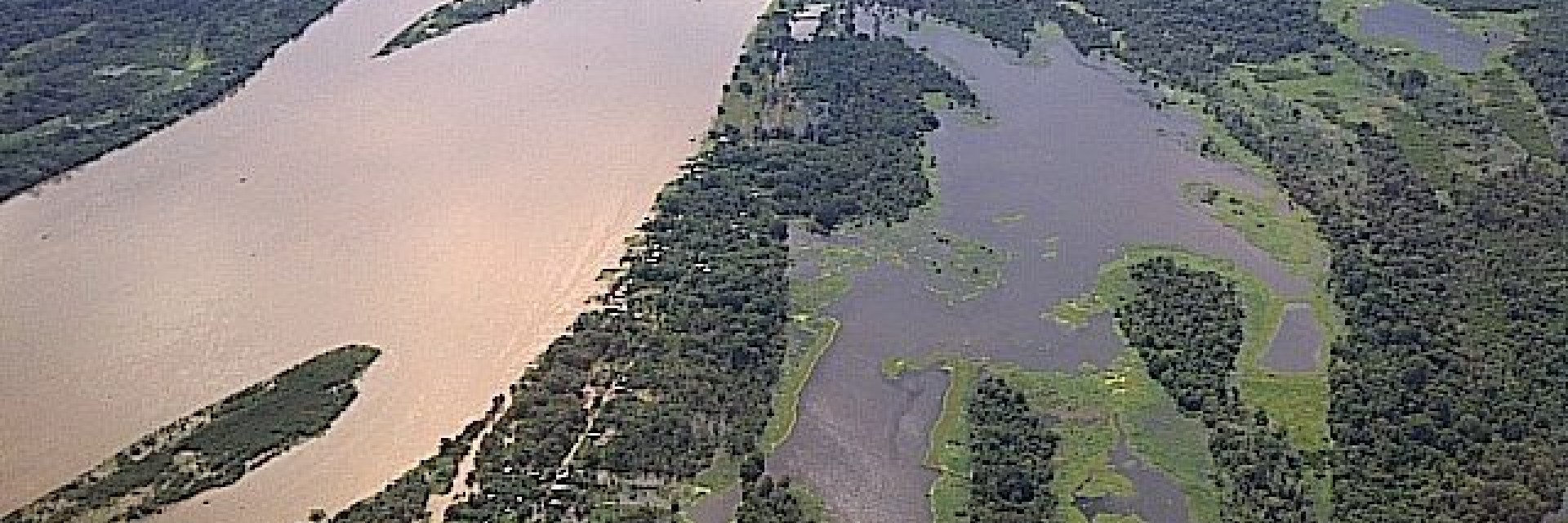
The Amazon
Amazonia is a large plain land covered by the hugest forest of the inter-tropical world and crossed by the worlds most powerful river. Its surface adds up to almost six million square kilometres and spreads over nine countries: it covers three fifth of Brazil, Colombia, Peru and to a minor degree Bolivia, Venezuela, Ecuador, Guyana, Surinam and French Guiana.
Its population doubled in thirty years but it remains weak with regard to its huge economical potentials including various activities like soya, palm oil and biofuel exploitation as well as mining and hydroelectric energy production. And of course the tourism: more and more travellers are looking for adventure and discovery, setting out for sojourns, round trips, excursions and treks in Amazonia.
The Climate
The region benefits from warm and humid climate with an average temperature of 26 °C. Rainfall varies from 2100mm/year to 2450mm/year, reaching its maximum of more of 10 000mm rain /year in the North West of the region.
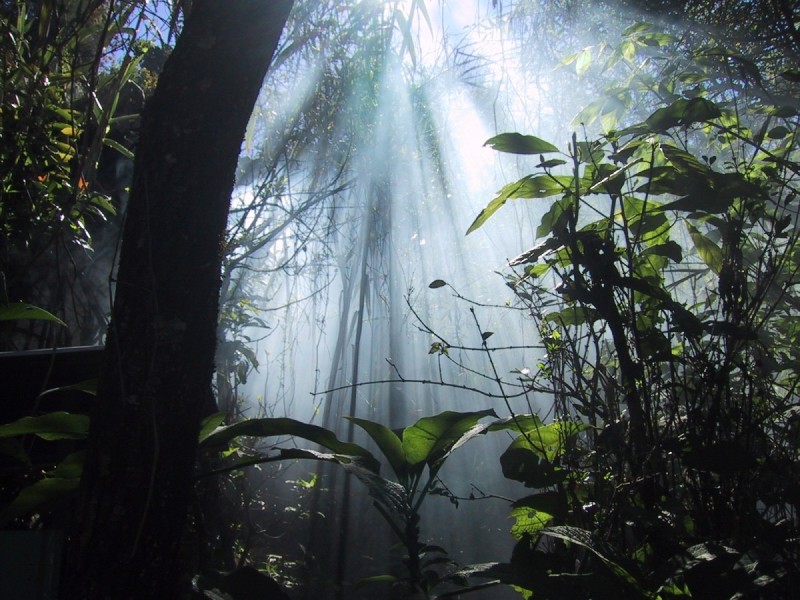
The Forest
Together with the forests of the Pacific-Asia Basin and the Congo, the Amazonian forest forms a green belt surrounding the earth.
Being the biggest rain forest of the planet it represents 50% of all tropical forests in the world.
Absorbing huge amounts of carbonic gas it helps regulating the world's climate and it is the origin of 15% of the water of all the rivers on the planet.
In spite of being attacked from all sides, 80% of the Amazonian Forest still remains intact.
Thus it harbours 10 % of all the plant and animal species, representing the last place of refuge for many among them.
An extraordinary ecosystem that you will be able to discover on your excursions.
Highland and Ground
The regional highland rarely reaches an altitude of 600 meters and most of the time it is lower than 200 meters, thus constituting the ideal conditions for trekking in Amazonia.
Parallel to the river's axis, on the sometimes flooded terraces, are the fertile grounds. They constitute hardly 3 % of the total surface.
The firm and never inundated grounds consist of nothing but sand, around one meter deep, and are covered with forest.
The Amazon River
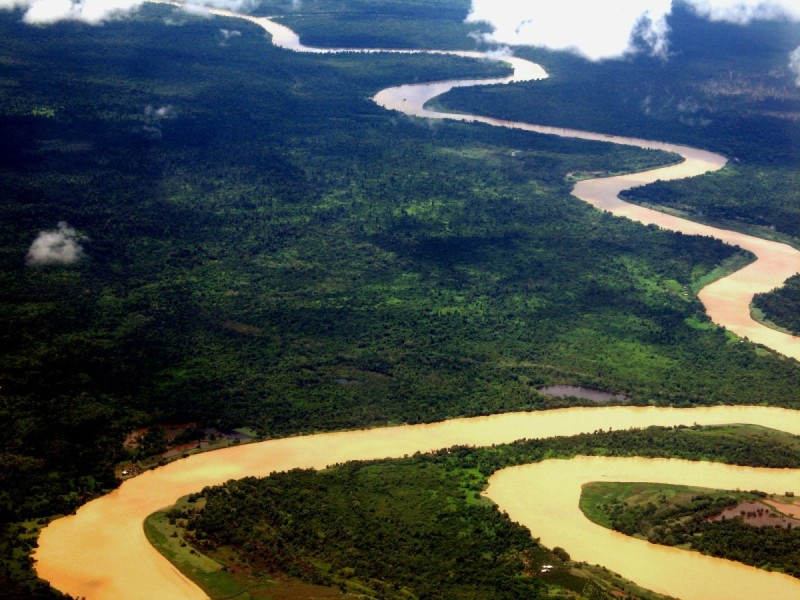
The Amazon river, with its 6400 km of length being the second longest river in the world right after the Nile, has its origin in Peru and ends in the Atlantic Ocean.
It is first in terms of water volume due to the largeness of its basin which, with a surface of seven million square kilometres, is the biggest on the planet.
The average flow rate at the mouth of the Amazon river is estimated at a volume of 180 000 cubic metres per second.
The different nature of its influent streams is due to alluvial soils: the Rios Negros carry iron and organic matters while the rios limpides d'agua limpa and the Rios Blancos carry bright and opaque alluvial deposits.
It's a spectacular phenomenon which you can discover during your excursions in Amazonia.
During the dry season the width of the river amounts to 4 or 5 km, whereas during the humid season, due to heavy rainfall, it can reach up to 50 km and the water's speed can rise above 8 km/h.
The hydroelectric power stations, like the one of Itaipu, take advantage of this power. However, projects like the mega flood barrage of Belo Monte in Brazil, for which the pharaonic construction works at the Xingu river have begun, are a threat to the indigenous villages which are defended by Chief Raoni.
Two types of rivers in Amazonia
The rivers, having their origin in the cordillera de los Andes, carry sediments and are of brown colour.
During the time of the river's descent its banks are extremely fertile and during 4 or 6 months one can cultivate plants like maize, yucca, manioc and plantain, which grow very fast.
The harvest thereafter has to take place before the river banks are flooded again.
The interval between maximum and minimum water-level is around thirty metres, but the banks can be flooded over several kilometres.
The land is very flat, hence the town of Leticia, point of departure of the treks and excursions, is at 4 000 kilometres from the Atlantic Ocean but only lies 80 metres above sea-level.
As for the rivers whose sources lie in the forest, they have the colour of red wine. Because of the high percentage of acidity, their borders are hardly fertile. Having their origin in the forest, these rivers rise a lot during the raining season because the swelled Amazon river blocks their exits.
The swelling of the Amazon river itself is due to heavy rainfall and to the melting of the glaciers of the cordillera de los Andes during summer.
The Amazon forest depends therefore directly on the Amazon river which itself depends on the cordillera de los Andes.
When the rivers level is low, it's the fishing season, when it is high, it’s hunting time.
Big and small rivers and lakes
The Amazonia basin is the greatest fluvial basin in the world.
Before the building of motor ways and air connections the rivers were the principal routes of communication in the region.
The Amazon basin comprises the Amazon river itself and its about 1100 influents, including the Rio Negro, the Rio Purus, the Madera and the Napo, which you will be able to discover during your circuits in Amazonia.
One of the consequences of the inundations was the forming of lakes, islands and side branches especially at the confluent streams of the big rivers Rio Negro, Madera and Tapajoz.
The principal lakes named Agoa-Redonda or round water are linked to the river by a complex network of flowing water bodies. The very lakes concerned here are called Cadaya, Saraca, Jamunda, Campinas, Surubiu and Urubucuara.
General History of the Conquest of Amazonia
The conquests of Amazonia by the Spanish and by the Portuguese were of different nature. The Spanish, attracted by gold, were not interested in the Amazon region. They arrived there, coming from Peru, with missionaries who crossed the Andes to evangelise the villages.On the other hand the Portuguese, they came by the Amazon river with big ships full of settlers of different professions: soldiers, scientists, merchants, etc.
Encounter between settlers and American Indians
When Christopher Columbus arrived at the cost of which is today Brazil, he wanted to merchandise with spices like in India, whereas the peoples of Amazonia were waiting for the arrival of the Messiah. Also, when Columbus met the natives for the first time, they offered him a hammock and a ball of cotton fibre, symbolic objects traditionally given to newborns. It was a religious gesture, as the hummock represents the uterus, the two strings to fix it the feminine and the masculine, while the ball of cotton fibre should serve to weave his clothes.
Christopher Columbus saw in this gesture an economic exchange, which later turned out to be a great discovery. In effect the hammock, hanging in the ship, enabled him not to fall out of his bed because of bad weather and to stay certainly balanced. This way, the marine has been using it since 1700 and, in the moment of sea battles, it was shouted: “Commotion of combat”, which was the signal to coil ones hammock in order to use it as a shield.
Later the Indians gave to Christopher Columbus a crown made of blue, yellow and red feathers, constituting the three primary colours (taken up again by the catholic church and the trinity: father, son and holy spirit). And they offered him coca and tobacco which soon would become very lucrative industries.
Francisco De Orellana discovers the Amazon river
It is around 1530 that Francisco Pizarro and Francisco De Orellana take off on expedition from Peru, in the research for the Amazonian cinnamon, a very precious spice which was imported from India at the time. 400 Spanish men, 200 horses, 500 pigs and 4 000 Indian prisoners: the story of this incredible expedition is told in the excellent book of William Ospina, “The Cinnamon Country”.
Historical versions rebuting the previous...
It is said that Christopher Columbus rediscovered America at the end of the 15th century. But there would exist maps of South America drawn long before Columbus by the Vikings ant the peoples of Asia and Oceania, conserved secretly by the Vatican...
The different eras of exploitation of the Amazon rain forest and its inhabitants
The Amazon rain forest suffered different types of exploitation over the years. In the 16th century it was exploited for sugar cane and the production of rum and ropes for the ships, for wood and ship production and for the trading of fruits, vegetables and meat with the indigenous.
As the first viral diseases appeared in South America many indigenous died of the measles, pox and above all of the flu.
Later, in the late 19th and early 20th century, with the beginning of the industries and the first world war, a second huge era of exploitation started with the rubber plant. Then, the seeds of the rubber plant were transported to and sawn in India, and the gigantic exploitations there put an end to its culture in the Amazon region. But, during the second world war, the Japanese blocked the access of the English to these plantations. So a new wave of exploitation of the rubber plant took place during this time.
More than 75% of the indigenous population died subsequently of the bad treatment administered by the Anglo-Peruvian enterprise “La Casa Arana”. Its owner, Julio César Arana, baron of the rubber plant and living in Maurus, the capital of the Amazonas department in Brazil at the time, was later denounced of the Brazilian consul and condemned and executed in England.
In 1960 the intense exploitation of skins and fur started: jaguars, otters, wolves, lamantins, guacemayas and other caymans, as well as the exportation of living birds (gucamayos or parrots) and monkeys. This commerce would finally be prohibited in 1985. In the 80s it was cocaine, produced from coca leaves and chemical products, which caused a destructive exploitation with many human victims, most of them among the native population. 1990 was the beginning of the exportation of fish for western aquariums.
The tourism appeared at the beginning of the 1970s, at first for few wealthy personalities as for the difficulties in accessing the region and because of the missing infrastructure. Nonetheless, in spite of the globalization and the appearance of the first plastic bags, the first motor vehicles and mobile phones in the 80s, the tourism industry today is turned towards the most respective forms of eco- and ethno-tourism, which also inspires all of our treks and excursions in Amazonia.